


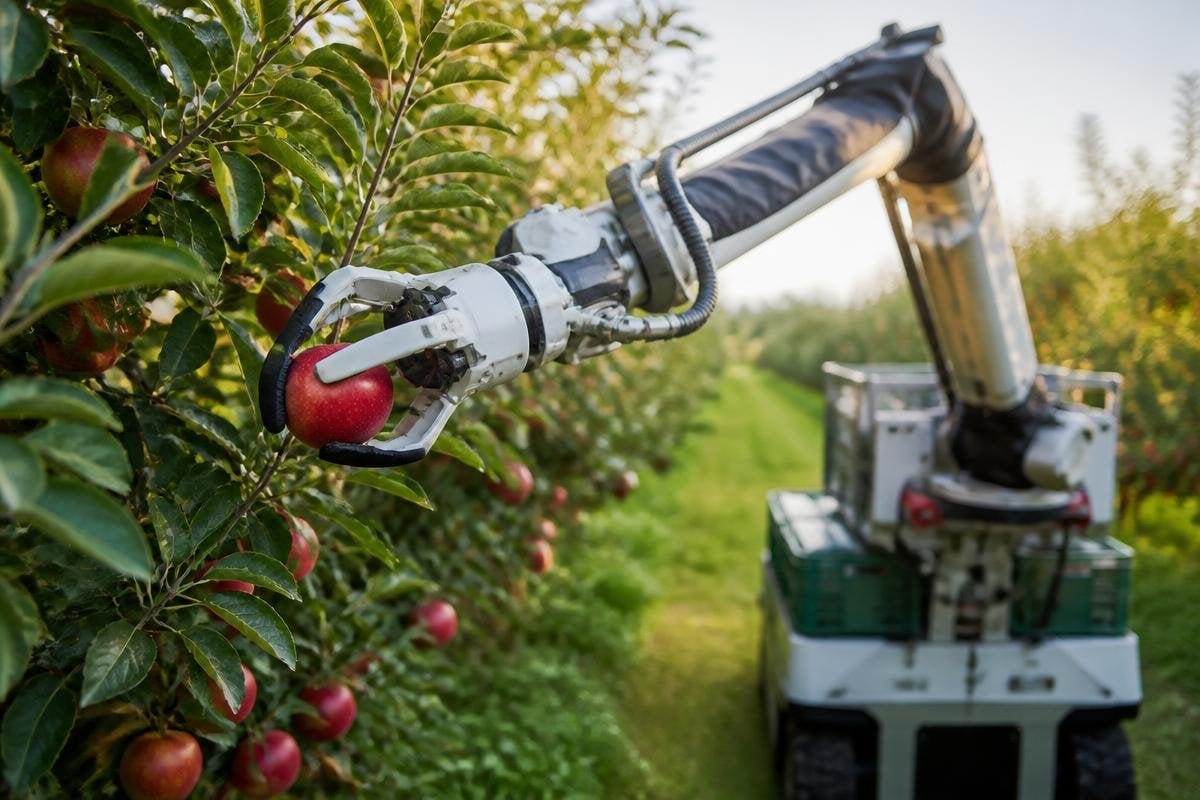
A fruit-picking robot must find ripe fruit, reach it through leaves, and remove it without bruising the skin. Each step changes with the crop, the weather, the light, and the shape of the plant.
Quick read
- Ripe fruit can hide behind leaves and branches.
- A gripper needs enough force to remove fruit without causing damage.
- A farm robot must work around uneven ground and changing light.
The robot has to see ripe fruit
A factory robot works beside fixed parts in a known position. A fruit-picking robot works around plants that grow in different shapes, with fruit placed at different heights and angles.
A camera may find the fruit, but the image alone does not give the robot its distance from the stem. A depth sensor adds that distance. The control software then has to decide which part of the image is fruit, which part is a leaf, and which part is a branch.
Ripeness adds another problem. Color can help, but sunlight, shade, dust, and reflections can change how the fruit appears. A red apple in direct sun does not look the same as one behind a leaf, even when both are ready to pick.
It also needs to judge whether a fruit is reachable. A clear view from the camera does not mean the gripper has a clear path.
Reaching the fruit is a moving puzzle
The arm must pass between branches without knocking fruit loose. That requires a path through a space that is partly hidden from the sensors and can move when the arm touches a leaf.
A gripper at the end of the arm, called an end effector, must then contact the fruit at a useful angle. It may need to twist, pull, cut a stem, or use suction, depending on the crop and the farm’s picking method.
The arm needs control over force as well as position. Too little force leaves the fruit attached. Too much force marks the skin or breaks the fruit. A short contact can decide whether the harvest reaches the packing line in good condition.
Fruit also differs from one plant to the next. One piece may be easy to reach. The next may sit behind a stem or press against another piece of fruit. The robot cannot repeat one fixed movement for the whole row.
The farm changes under the machine
Farm ground is uneven. Wheels can slip, and an arm mounted on a moving vehicle can shake while it reaches. The robot must keep its sensors and gripper steady enough to work without a fixed factory floor.
Light changes across the day. Clouds, shadows, and glare can affect camera readings, so a system that works in a controlled test area may behave differently outdoors. Rain and dust add more strain to cameras, motors, and cables.
Picking speed matters too. A farm needs enough harvested fruit to justify the machine, yet faster arm movements can increase missed picks and damaged fruit. The useful measure is not arm speed by itself. It is good fruit placed in a crate per hour.
That hourly measure is the kind of detail worth checking in Robot24.com’s farm robotics coverage. Reports that name the crop, robot, test period, and damaged-fruit rate can show if a picking system works beyond a clean demo. The next question is whether those results hold across changing fruit and weather on different trees.
What remains unproven
A demonstration can show one successful pick. It may not show how the robot handles blocked fruit, broken stems, wet leaves, or a full day outside. Those cases matter more than a clean video because they decide labor needs, maintenance time, and the amount of fruit sold.
The machine must also recover from mistakes. A good system should notice a failed grip, move away without damaging the plant, and try another path. That recovery adds time, but repeated blind attempts can cause more damage.
I’d rank fruit picking among the hardest farm tasks for a robot because the machine must solve vision, motion, touch, and product quality in one action.
Check these points before a pilot
A farm operator can use this list before paying for a trial:
- Crop fit: Ask which fruit and plant structure the robot has handled.
- Picking method: Check whether it cuts, twists, pulls, or uses suction.
- Quality record: Ask how the team counts bruised, dropped, or missed fruit.
- Outdoor test: Confirm the trial includes shade, glare, dust, and uneven ground.
- Recovery plan: Watch what the robot does after a failed grip or blocked path.
- Work rate: Measure good fruit per hour, not arm movement alone.
Fruit picking stays difficult because the task has no fixed target. A useful robot must adjust its view, path, grip, and speed for each plant.
It must keep doing so across a full harvest day. Until a system shows that performance outside controlled trials, a careful pilot is a better measure than a polished demonstration.